Digital Rem
Who am I when I’m online? That’s my preferred definition of digital identity, similar to the one used by Eric Stoller. It’s the face I show to others when I’m on the internet. It’s the bits and pieces of my personality that I leave behind, creating an impression of me as a person.
Or rather, the impressions, plural: as I’ve gotten older, my online presence has been split in half. To show this progression, I’ll arrange this post into three main parts: the unified past, the personal present, and the professional present.
The Unified Past
For a millenial, my entry to social media was extremely young. My elementary schooling came in the form of distance education, which is essentially a middlepoint between regular public school and home schooling. As a result, I’ve been emailing and chatroom-ing with my friends and teachers since I was a small child. Add in a few massively multiplayer online games, and it’s clear that I’ve had a digital identity for as long as I’ve had any sort of identity.
Speaking of games, my first real experience with public, widespread social media was when my cousins convinced me to get a Facebook account to play a game called Farmville.
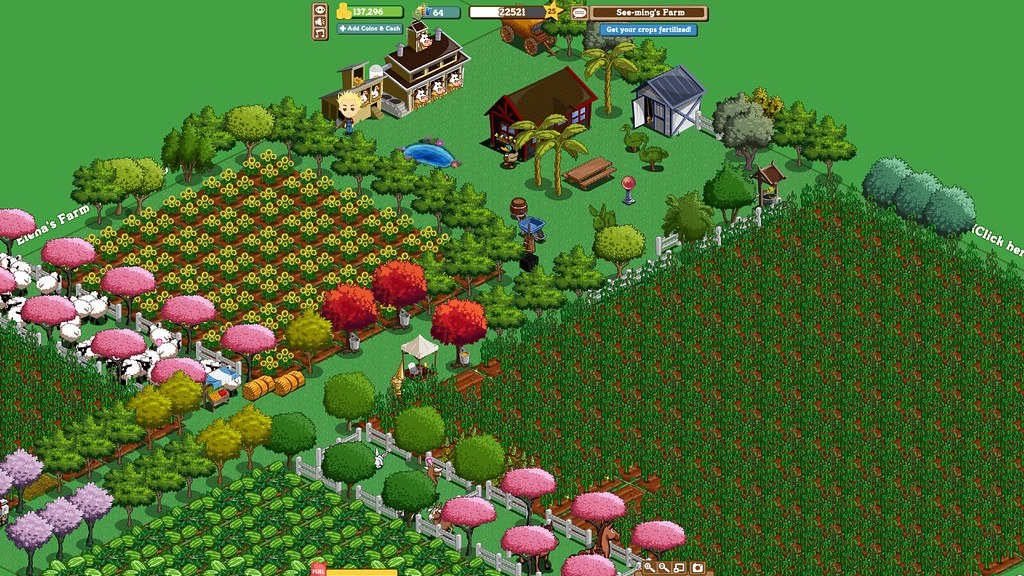
Then, just a few months later, when it started spreading like wildfire through my high school. My motivation for participating changed pretty quickly: Facebook ceased to be about virtual farming, and became about making and maintaining friends.
Suddenly, the account I used to pick virtual potatoes needed content. Posting photos, chatting, sharing whatever witty and/or edgy thoughts popped into my developing brain… These activities seemed so important at the time.
Some of them were important: I spent hours chatting with the woman who is now my wife. That turned out to be a pretty good use of my time!
Some of them weren’t: a few years back, I did a deep dive to find and delete any embarassing photos or mean-spirited jokes (luckily, I didn’t find many).
Both of these use cases speak to why my social media use changed: I needed more private platforms for personal communication, and a more professional way to present my digital self to the world at large.
The Personal Present
Nowadays, my wife and I don’t spend all night sending Facebook messages. When we’re not together in-person, I talk with her, most of my family, and all of my best friends on Discord. Think of it like a mini-Facebook, split into invite-based servers, featuring both text chats and live, multi-user audio/video calls.
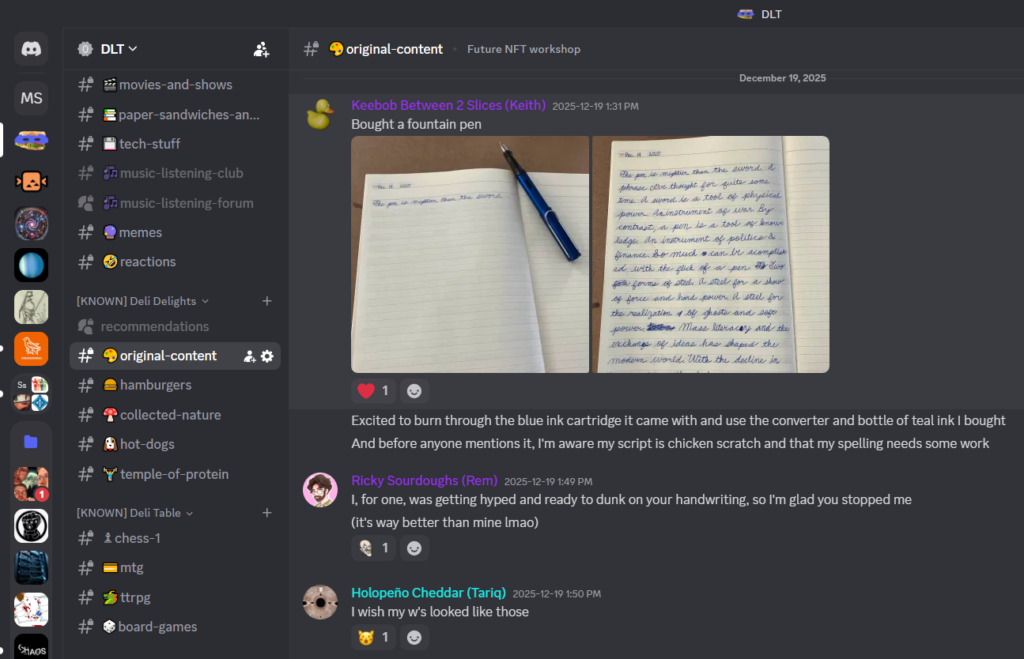
While I am a member of some public servers (including UVic course-related ones), the vast majority of my online leisure time takes place in just one: a personal server which has been administrated by myself and about a dozen friends since peak COVID times.
No online presence is truly anonymous, but the digital self I present to this server is very closely tied to how I come off in-person: most of these people are in my home every couple of weeks, so it’s difficult to tease apart the two identities.
Nor would I want to: for me, the entire point of this kind of social media is to maintain connections which already exist in the real world… Or, in rare cases, to do the reverse: one of my best friends met his fiancée on our Discord server, and another made the decision to leave the United States and come study at UVic based on the connections they made there.
The Professional Present
This part’s not as much fun, but it sure is important: digital identity is very much a functional, marketable part of who I am. As someone who works and studies in tech, I would be shooting myself in the foot if I didn’t have a presence on both GitHub and LinkedIn.
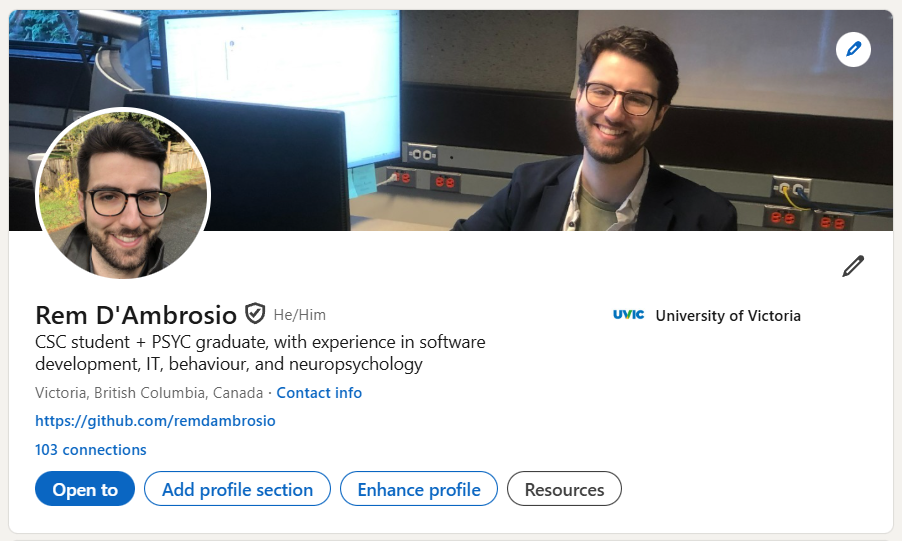
You might notice that unlike Facebook, the links above go directly to my profiles. Both are quite public: if you head there right now, you can snoop around without adding me. That’s the main purpose of these platforms (well, GitHub is a useful tool even in isolation, but that’s a different discussion): they’re meant to sell myself to the general public.
Employers and collaborators can look me up on LinkedIn, and see a version of my life which is curated for their eyes. They can click over to my GitHub, and see the cool things I’ve built. This digital self is constructed with more-or-less one motivation/reward in mind: landing me a job!
As a result, it takes very few risks. You won’t find any eye-rolling thoughts I had in high school, or embarrassing photos. You also won’t find the same version of Rem you’d meet in-person, under pretty much any context: even my job-interview-self has a few more quirks than my LinkedIn self.
Synthesis, Sometimes
Even in the controlled, employer-friendly version of my digital identity, I like to drop a few hints regarding my more personal self.
It only takes three clicks to get from that manicured LinkedIn page, to a GitHub repository, to a simple video game I made. It features wizard-ified versions of my friends from the aforementioned Discord server, and also a rap I wrote to teach people the rules and keep you entertained on the menu screen.
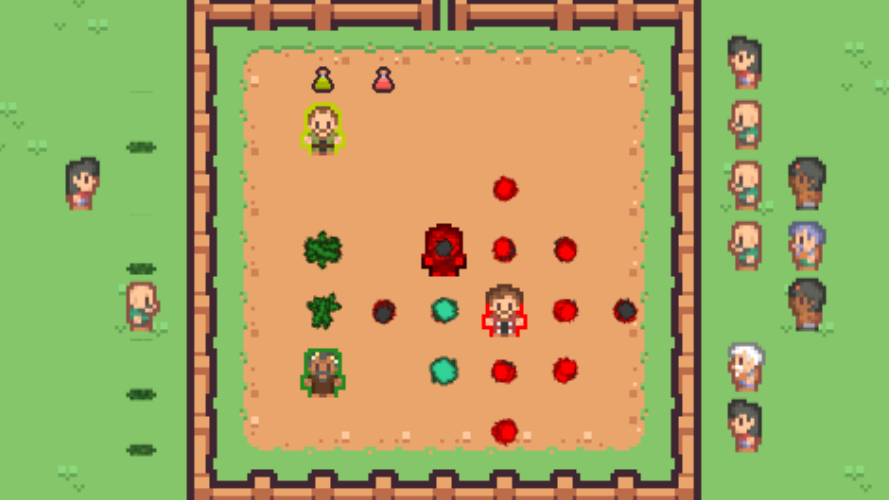
You can play it right now–Or an employer can–Or anyone can.
It’s a little weird, and a little embarrassing, but that’s also part of the commodified Rem: I know that I’ll do better at a job which wants and appreciates this kind of passion. I’m gambling on someone recognizing that.
Or maybe I just want to come off as more of a human, because that’s the kind of thing a human does: blurring the line between personal and professional, and letting my interests shine through in my work.
It sounds like learning how to do that the right way will be a core aspect of this course, and I wouldn’t be surprised if it comes up again in future posts.