You can’t spell PLAN without PLN and AI…
…But that only works if you drop the “I”, which you probably shouldn’t.
Before diving into a discussion of the inclusion of AI in a PLN and the notion of AI literacy, I want to briefly talk about what “AI” actually means.
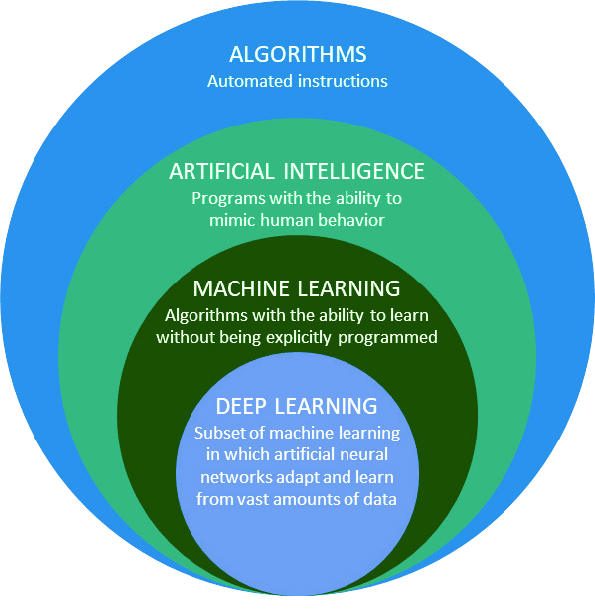
Generally speaking, AI is a ridiculously-broad term which encompasses decades of computer science research and practical applications, including everything from The Wumpus World to robo-vacuum pathing to translation software to ChatGPT.
Today, I’ll be using “AI” to mean GenAI (generative artificial intelligence): a specific application of deep learning, which uses neural networks and outputs content resembling something a human might make (writing, images, etc.).
I want to call attention to this distinction because every teacher and every learner is going to see more and more things called “AI”, and a lot of people arguing over whether that’s a good thing. You’ll hear plenty of cut-and-dry arguments like “AI is bad for learning and makes people stupid because X”, or “AI is a useful tool and should be allowed because Y”.
It’s important to remember that these types of arguments can’t lead anywhere useful unless all parties can agree on what they’re discussing. It’s my experience that people are eager to call software “AI” if they want to hop on a hype- or hate-train; if it’s boring and non-controversial, then it’s just “algorithms”. Once you start looking, you can find a lot of No True Scotsman in this area.
So let’s narrow the discussion to GenAI, and go from there!
Assistance, Abdication, and Accessibility
In a recent post from Chris Kennedy’s blog, the B.C. superintendent discusses the notion of assistance in the context of education, writing, and AI. Referring to In Praise of Assistance, he frames AI as a method of assistance, which is primarily considered a “good thing” in the context of teaching.
But to generalize this to AI, a question must be answered: “What kind of assistance builds thinking, rather than replacing it?” I’ve heard this question before, but Kennedy’s answer is the best and most concise one I’ve seen: “Assistance is not the enemy of learning. Abdication is.”
A disclaimer: I don’t think it’s right for me to lecture anyone on the ups and downs of using AI as a writing tool. I have never used AI to write or edit my English-language content… Not because of any ethical barrier, but because it’s not an area I need help in. Through both fortunate life circumstances and interest/effort, I am confident in my writing. To boil it down to a test score: I placed in the 99th percentile on the “Verbal Reasoning” section of the GRE (an exam for prospective grad students).
I say this not to brag about my qualifications, but to minimize them: I am not the target audience for AI writing tools. Essay-writing does not take up a significant part of my time. It’s been a long time since I felt the pain of not being able to express myself quickly or effectively in English…
…But I do use AI to write in other languages, like Python, C, Perl, and Haskell.
AI is a powerful tool for programmers, so I’m no stranger to debates regarding assistance vs. abdication: in the context of software, using AI can streamline your grunt work, enable prototyping far beyond your ability, and help you generalize your learning across different programming languages… But if you let it take the wheel and “vibe code” irresponsibly, it carries great risks (for both your own development, and for the integrity of the resulting software).
Stepping outside of my own experiential bubble, it seems this applies to writing in English (and other non-nerd languages) as well. Kennedy wisely points out the ideal use pattern of AI as “a Socratic tutor”, but warns that there isn’t a method to ensure that students will use it in this way.
Perhaps we could shrug and say that the students (and teachers) who truly care about their learning will use AI responsibly and reap the benefits, while the lazy ones will choose to abdicate… But that’s a dangerous way of thinking, especially when we’re talking about children struggling through a high-pressure and inequitable system. Like all forms of plagiarism, abdication-via-AI doesn’t come from nowhere: factors such as extrinsic motivation and low self-efficacy are often behind this behavior.
As Kennedy says, “the myth of the autonomous writer has always favoured students with the most support”, and the proliferation of AI risks widening this gap.
So what can we do about it?
AI Literacy
A study from Brock University focused on teacher candidates and their “AI literacy”, which I would define as “one’s understanding of the basic mechanisms and practical capabilities of GenAI”. The findings supported the notion that even when candidates have relatively-low AI literacy, they see it as an important topic: they know it’s not going anywhere.
The candidates were also asking the right questions: they want to ensure that students use AI to assist without abdicating, but they don’t know how.
I think the answer may be a little cyclical: the solution to AI abdication is AI literacy. Students (from elementary school kiddos to teacher candidates) need to know what AI can and cannot do. They need to know which uses are beneficial, and will save them the most time and pain in the long run. They need to learn the dangers of misuse, in an environment which is practical instead of alarmist. The last thing we need is another DARE.
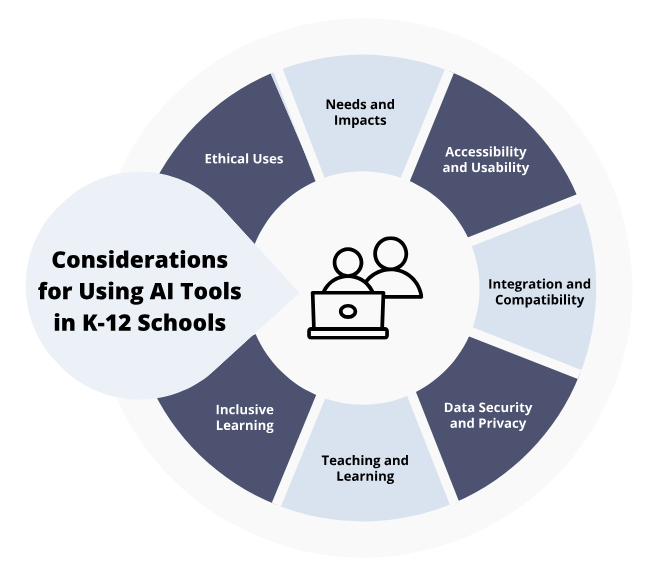
Luckily, progress is being made: I was pleasantly surprised to find that the B.C. Government has this page, so clearly there are some people putting thought into this great (and growing) issue.
My Own Use: LLMs in my PLN
Putting aside my use of GenAI for programming, how else is it involved in my PLN? While I don’t use large language models like ChatGPT to help me write, I have taken advantage of them for studying.
As someone who has studied (and even worked on) AI chatbots, I don’t have a general sense of trust for the information coming out of ChatGPT: it’s prone to hallucination, especially when it comes to niche topics which it may not have been sufficiently trained on.
Instead, I have used my own class notes as an input, and asked ChatGPT to quiz me on them in a question-and-answer format. It’s a bit like using flashcards, only with more flexibility: I can ask for hints, or flip things around (ex. providing definitions when given a term, or vice versa).
Another use case is expanding a given pool of practice questions to create more study material. For one programming class, I provided ChatGPT with a list of practice problems, then asked it to generate ten more problems of equivalent difficulty. The key aspect of this is verification: I don’t need to trust whether ChatGPT’s answers to the questions are correct, since I can use other sources within my PLN to verify the methods I use. For a programming class, all I had to do was run the code and see if it worked as expected!
The “question-and-answer” use case above highlights the use of AI without abdication, while the “generating practice questions” use case demonstrates an application of AI literacy (specifically, knowledge of an LLM’s limitations and how to safely navigate them).
Again, I’m a fortunate person. I don’t have these skills because I’m smarter than anyone else: I picked them up along the way, as a computer science student with friends and mentors who have been studying AI for years–Before, during, and after the advent of GenAI.
As someone who agrees with both Chris Kennedy and the majority of those teacher candidates, I’m very happy to see AI literacy spreading beyond the nerds in my niche.
Great post. I really resonated with your point about being more selective with what we share and consume. It is so easy to just scroll and repost out of habit without thinking about the digital identity we are building. Your example about changing how you use Bilibili makes perfect sense. I am also working on my EDCI 338 blogs right now and trying to map out my own online platforms, and it definitely opens your eyes to how public our casual scrolling actually is. Do you think you will ever try to completely separate your personal and professional accounts, or just keep managing them together with this new intentional mindset?
oops wrong blogpost had this tab open too.