Mapping my Apping
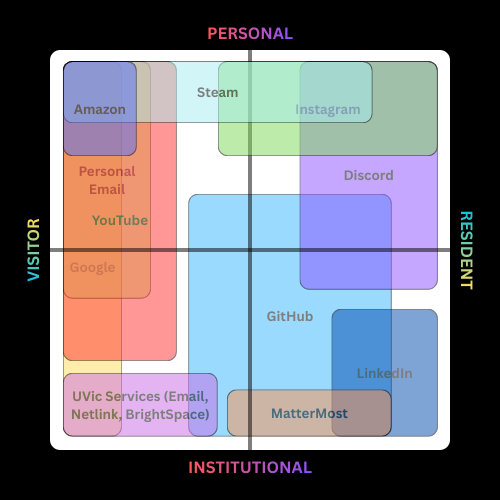
Let’s hit the ground running with my own VR map, created in Canva according to the Digital Visitor and Resident Framework:
Methods
While more lengthy and technical details of VR mapping can be found through the link above, I’ll go into my personal methods here.
First, I wanted to include about 10 of my most-used apps/websites/tools (I ended up with 11). When possible, I tried to pick broader online spaces instead of specific functions: for example, I included “Steam” instead of every single online video game I play, “Discord” instead of a specific server, and “UVic Services” in order to consolidate the various tools which use a single NetLink ID.
Mapping my usage to the Personal/Institutional Axis was quite simple. I just asked the following question: “How much of my usage is forced by, and related to, work and/or school?” Please note that this doesn’t map to enjoyment: I certainly wouldn’t be on MatterMost if it weren’t for this class, but it’s been a pleasant experience so far!
On the other hand, when mapping to the Visitor/Resident Axis my main criteria was: “Do I make a mark here? What is the ratio between content contributed and content consumed?” Even if I feel very familiar with an app, or enjoy using it daily, I can’t be a “Resident” if I only use it as a tool to retrieve information or buy stuff.
Trends
Looking at my completed map, I see a few trends which I didn’t predict going into this exercise:
- GitHub is the only platform which crosses both axes, with my usage fitting into all four quadrants. I think this is fairly standard for programmers, especially students and/or job-seekers. Despite GitHub’s relatively sparse and unassuming interface, it can be used in many different ways, most of which I participate in on a regular basis. For example:
- A place to build and show off personal projects (Personal + Resident)
- A repository to download useful software (Personal or Institutional + Visitor)
- A platform for teams to collaborate on their work (Institutional + Personal or Resident)
- My two most Resident-focused platforms, Discord and LinkedIn, were the same two services that I compared and contrasted in my previous blog post. In retrospect, this makes sense: that post focused on digital identity, and it seems that residence and digital-identity-building go hand-in-hand.
- Notice the crowding on the left side of the map: I use many tools in a fully Visitor-like way, but very few tools in a fully Resident-like way. I think this may be for two reasons:
- Engaging as a Resident takes more time and effort than engaging as a Visitor, so I cannot treat every platform in this way for practical reasons
- The experience of a Resident is often very customizeable: this means that I need relatively few platforms in order to have a broad range of experiences
Questions
Q: What digital platforms am I currently using to develop my professional network?
At first glance, this felt like it would have a simple answer: GitHub, LinkedIn, and simple person-to-person communication (whether through email, text, or in-person meetings over coffee).
But when I consider it a little further, almost every platform in my map has been used to develop my professional network, at least to some degree. I’ve looked up interviews with potential employers using YouTube, played games with colleagues on Steam, and found study buddies via Discord.
Q: What should we consider in expanding our professional learning networks?
A little bit of everything, all some of the time.
I find the best approach is to access a wide variety of purpose-built platforms, but not to spend too much time on them (this strategy is evident in the Visitor/Resident divide in my map, discussed above).
As connections with like-minded (or complementary-minded) individuals are made and strengthened, sometimes they will shift over to other platforms, where they become co-Residents: think following someone you met at a conference on LinkedIn, or friending a classmate on Discord.
Q: How would an employer respond if you applied for a job with them and they assessed your social media presence via your digital identity?
I hope that I’ve done a good job of creating a divide between my personal and institutional social media use… But nothing on the internet is truly anonymous, so I should work from the assumption that they will find and examine ALL of my presence.
With that in mind… I feel pretty good about what they’d see. Even the things which most embarrass me are more childish than they are problematic, and I think the overall impression of my digital identity is one of curiosity and growth.
In keeping with that mindset, I’m looking forward to seeing other students’ VR maps–Particularly if they include the same platforms in different quadrants.
Hi Rem,
First of all I wanted to say I very much enjoy all the titles of your blog posts thus far 🙂
I thought your explanations as to how you decided which service should go where were clear and agreeable, as well as your analysis of the trends you noticed.
While I’m not an employer, I do think that from what I’ve seen of your blog posts and interactions on Mattermost, “curiosity and growth” is an apt description of my impression of your digital identity as well.
I really appreciate that!
Hey, I really enjoyed reading this, and ‘Mapping My Apping’ is such a catchy title. Your breakdown of GitHub was super insightful, I hadn’t really thought about a single platform being able to cross all four quadrants like that, but it makes total sense for programmers. Since it’s so central to your map, do you feel like that’s the platform where your digital identity is the most authentic or does that still happen more on the personal/resident side like Discord?
Thank you! I would say that while GitHub says a lot about the way that I like to work and be creative, Discord is definitely more authentic in terms of reflecting my in-person personality, mannerisms, and humor. I do a lot more talking there, with people I know better, and with no ulterior motive re: putting out an interesting project for future employers to see.