Like Minds and Mindful Liking
Instead of ending this post with a song recommendation, I think it makes more sense to start with one.
Why did I choose this song? Am I trying to tell you something about my political beliefs, or my queer identity?
Not exactly: the most realistic answer is that I heard the song and liked it at an early age. My mom had the original version on a CD while I was growing up.
She would play it in the family van sometimes, and one day I asked her what a “union” was. She told me, and then she explained what she believed about unions, and what other people believed.
We also listened to Christmas music, and I asked her who this “Virgin Mary” was, and she told me that too. She explained what she believed, and what Christians believed, and why my aunt was a different kind than my nonna.
Similarly, when my father had arguments about urban planning and local politics with friends from Northern Europe or Eastern Canada, he would let me get involved in the conversation. He told me which side he was on, and why, and how I could find out more.
In my opinion, this is good parenting: communicating your values without enforcing them, while also saving space to explain and understand the values of others. Doing this objectively is far from a given: the majority of parents seem to pass along their viewpoints, intentionally or not.
Me and my parents are likely no exception: I do support unions, after all. I’ve spoken in support of mixed-use development. My opinions on the veracity of views expressed in Christmas lyrics are similar to those of the people who raised me.
But to me, the important aspect is the trying. The attempt at conveying a broader truth than one’s own. Teaching empathy for people who had different paths than you, and who were (and are) exposed to different information. This is what a good parent does, and what a good teacher does, and what a responsible user of social media does.
“This is what I believe, and this is why. This is what others believe, and this is why.”
That sounds like a model we can apply to our PLNs.
A Healthy Echo Chamber
Any kind of network is going to involve people who are alike in some way or another. It’s going to be a “biased sample” of the general population, where that bias reflects the purpose of the network (directly or indirectly).
Given that, it seems likely that any sufficiently-focused network will become an echo chamber. According to a recent literature review, that process may be even more pronounced when a user self-selects which part of a network they’re exposed to, resulting in an “information cocoon”.
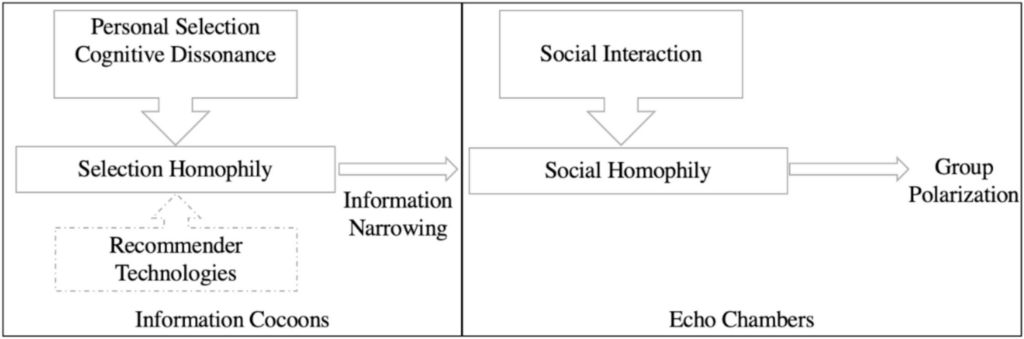
Notice those “recommender technologies”? When people call out “the algorithm”, that’s what they’re talking about. It’s not a sinister centralized force (though it certainly can be sinister). It’s just the collective effect of the tools you use trying to recommend things which they think will engage you.
An algorithm can be altruistic (“this user wanted this information, so some related information will probably be useful as well”) or selfish (“this post made them angry enough to stay on our app and look at more ads, so this even-more-inflammatory post might make them stay even longer”). As you may notice, those two scenarios aren’t even very different, aside from the motives I’m assigning to them.
So, if echo chambers and information cocoons are inevitable, what can we do about it? Again: expressing a view while leaving space for others. Living in a bubble while acknowledging that it is one, and peering outside. Trying to seperate “this is what’s true” from “this is what I believe”, by shining a light on the intermediate steps.
In Jesse Miller’s video for Week 4 of EDCI 338 (hi Jesse), he brought up podcasts and how they can reinforce views. My favorite podcast certainly does this, but in a way that’s as informative and fair as a listener could ask for.
Sawbones: A Marital Tour of Misguided Medicine is a podcast which focuses mainly on dangerous medical trends and misinformation, from Ancient Greece to present-day America. Given this, it naturally appeals to a listener with a certain set of viewpoints. The couple who host the show (a comedian and a doctor) have their own political beliefs, and will not hesitate to communicate them (especially when it comes to the healthcare system they work and live under). In fact, one of the hosts got mad enough about it that they ran for public office!
But hard lines are drawn between “this is what the data currently shows” and “this is what I believe”. Even more importantly, empathy is shown towards people who the hosts (and I) believe are just plain wrong. For example, the question “why would someone believe in an alternative medicine practice which has been studied and proven to be BS” is often answered with some variation on “well, they were repeatedly abused and mislead by the medical establishment, and are desperate for other answers”.
That approach is far more kind than making fun of people and other-ing them. It’s also far more useful, if your goal is to maintain an inclusive and diverse PLN: views from outside of your network should be discussed, not ignored. We should talk about why people believe what they believe, rather than how silly that belief makes them look in our eyes.
A Practical Suggestion for Our PLNs
Remember that algorithm? Thanks to regulation and the hard work of privacy-conscious people, you do have some degree of control over it–And you can use that control to make your PLN more robust. Since I’ve embedded two YouTube videos in this post, I’ll use that as an example.
Behold, my YouTube front page:
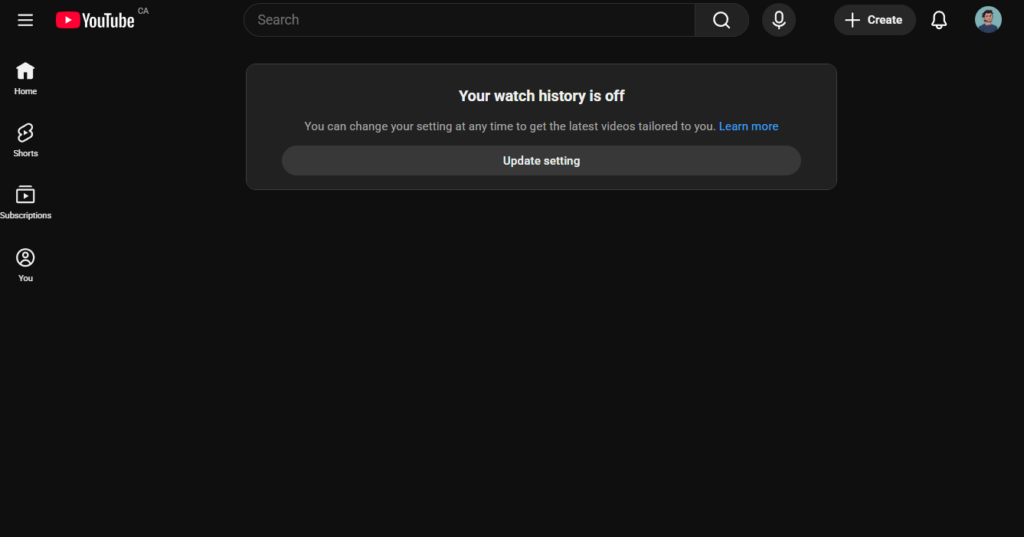
I’m not about to stop using YouTube as part of my PLN: it contains far too much useful and easily-digestible information. But as far as PLN components go, one of the most heavily-monetized, algorithm-driven, echo-chamber-conducive digital spaces you could imagine.
You’ve likely had the experience of clicking on a weird-looking YouTube video out of curiousity, then getting some odd recommendations. This can occur whether or not you have an account, though having one makes it much more pronounced. If you fall too far down the recommendation rabbit hole (and it doesn’t take long), your YouTube account may no longer be able to provide exposure to diverse ideas.
So… I turned it off.
If you’re interested in doing the same, just go to this page, then scroll down to “YouTube” and start unticking boxes. You can delete previous activity, and stop it from recording new activity.
Keep in mind that this will disable scrolling through Shorts, and make it harder to pick up old videos where you left off. It also makes the front page less useful for finding new content: instead, I have to use the Subscriptions tab to keep up with my favorite channels, and recommendations from friends and/or other social media sites to find new ones.
When I see video recommendations in the sidebar, they only relate to the currently-playing video, and possibly my subscribed channels. No more cocoon-creating, echo-y rabbit holes based on past activity alone.
Are the tradeoffs worth it? That depends on who you are and how you use YouTube! But just being aware of and consciously making this decision (and many tweaks like it, for each app you use) gives you more freedom to shape your PLN.
Maybe you’re not willing to give up YouTube history, but there could be another app with another feature you don’t need. If that feature is damaging the inclusivity of your PLN, consider disabling it.
Thank you for the advice about fixing algorithms!!!
No problem! Social media sites are getting more invasive all the time, but sometimes laws re: online privacy catch up with new technology (it’s a slow process). When that happens, companies are often required to add opt-out settings for users who want to control how their data is used.
Hi,
I thoroughly enjoyed reading your post. I find it fascinating how childhoods can differ and how they affect us as adults, whether we gravitate toward what we learned growing up or move away from it. My father told me his side or gave me his opinions on something, whereas my mom was a bit more open-minded. I later learned they are who they are because of their own childhood.
Thank you for sharing the podcast and song. Neither of these would have crossed my radar. I have never given much thought to YouTube’s algorithms, but it makes so much sense why videos on topics I am interested in “magically” appeared and down the next rabbit hole we go. I am going to assume that Amazon and other online shopping platforms will pop up what I “need,” or how the items I search for come on sale, and Alexa will remind me.
I wonder how many other echo-y rabbit holes we go down in our PLNs that we do not even give a second thought to.