Anxiety, Identity, Creativity, Diversity
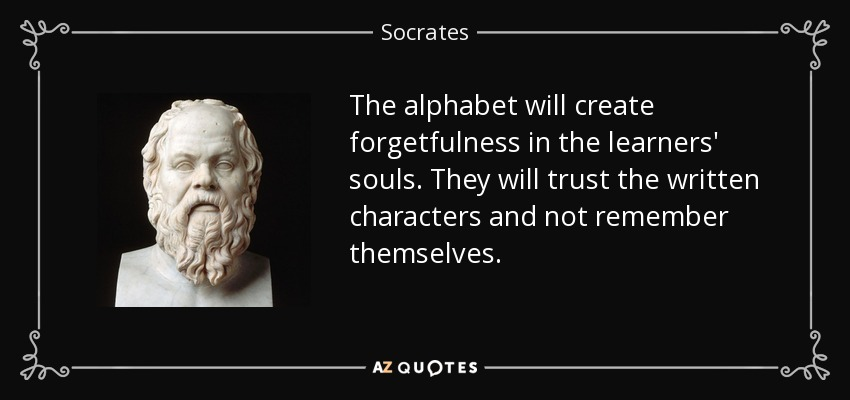
Harry Dyer’s TEDx Talk on Social Media in Education mentions several historical perspectives on new forms of communication. These accounts have since been dismissed as fearmongering by most people: the implication is that certain modern-day perspectives on social media may suffer the same fate.
This Macleans article sums up the long history of communication-tech-anxiety, from Socrates’ hot takes on writing (circa 400 BC) to a printer company’s “research” on IQ loss via email (in 2005).
While not all caution is bad, and not all tech is good, a reasonable takeaway is that there will always be people (even very clever people) with knee-jerk reactions to new forms of communication.
That’s why I’m in this course, and why I appreciate research like Dyer’s: it helps us separate sensationalism from measured criticism, examining why certain elements of new communication technology may be useful, harmful, or both.
Growth of the Digital Self
Speaking of those differing elements, Dyer’s talk brings up the notion of identity performance. This was the subject of my first major post.
As a millenial who started using social media right as it was first becoming mainstream, I had to figure out my various digital identities without any guidance: my parents and educators had no reason to teach me lessons like “have fun on this website; be professional on this website; curate your privacy differently on each”.
Nowadays, academia is catching up with the importance of these issues. For example, some of the recent work Dyer is involved in concerns the use of video-sharing platforms by children under 6 years old, which is certainly an important (and controversial) topic among parents and educators today.
Different Restrictions, Different Creativity
Form doesn’t just follow function: it often determines it. As Dyer discusses, a person’s behavior on a social media platform is heavily influenced by the nature of that platform. I refer to this in my previous post reviewing the different social media apps I use, and it also relates to my post about diversity and echo chambers: after all, “the algorithm” is a heavy-handed way in which the form of a platform can determine its function, on a per-user basis.
This chapter from Emerging Technologies in Distance Education discusses another “form determines function” phenomenon, in the context of learners and open source software. It refers to a finding from Alec Valintino Couros’ dissertation, indicating that learners who use open source tools can carry an “open source culture” to other aspects of their academic lives.
Learning for All
Another topic discussed in the same chapter of Emerging Technologies in Distance Education is Connectivism, a perspective which emphasises the importance of learning to access and synthesize knowledge sources. In other words, a strict connectivist might say that becoming proficient at forming and sustaining PLNs is more important than learning information directly.
The first principle of Connectivism listed is “Learning and knowledge rests in diversity”. When I heard this, and considered the context of this week’s question regarding working with the vulnerable sector, I was reminded of one of the items on my resume I’m most proud of.
LifeStreams Online is a platform hosted by the Garth Homer Society (GHS). GHS supports adults with developmental disabilities, and most of their programs (including learning and social groups) occur in-person at their facilities in Victoria.
As you might guess, the COVID-19 pandemic posed some massive problems for them. One of my first jobs after graduation (from my previous degree in Psychology) was building a large part of the LifeStreams website, to support clients and bolster programs which would have otherwise been cancelled due to social distancing restrictions. The mandate of our two-person LifeStreams team was to help bridge a new and growing gap in the PLNs of dozens of people, all of whom were in vulnerable positions (at a particularly vulnerable time).
This was obviously a tricky task, especially in relation to professionalism and regulations: we worked closely with both a handful of mental health professionals and a group of GHS’s clients, to ensure that the platform was useful for its target audience and maintained full accessibility and dignity for everyone involved.
That experience taught me quite a lot about how one segment of the population leans on their PLNs, and the importance of maintaining them. It’s part of the reason I take such an interest in the work of people like Dyer and Couros, which focuses on understanding social media and its potential benefits.
Hi Rem,
Thanks for the post! I enjoyed reading about your experience working on the LifeStreams website during COVID – I never considered the implications that the pandemic would have on things like a developmental disability support society. I also liked your point about how we should expect people to have a knee-jerk reaction to any new communication technology, whether they are in favour of it or oppose it. Do you think that these initial views from opposing audiences influence how an online communication platform grows over time?
Thanks! I think views from opposing audiences can have influence over how a platform develops, but it’s most pronounced if those views come from the demographics likely to adopt it. “Outsider” opinions (ex. those from older generations who don’t use the technology) often hold less weight.
Man you post such great blogs, tbh your posts have set a standard for me. This was a great post too. Your account of building the LifeStreams Online site during COVID made the links between anxiety, identity, creativity, and diversity feel concrete instead of theoretical. I kept thinking about how platform rules nudge people to present themselves one way or another, and how small design choices can either open up expression or shut people out. Your practical focus on accessibility and responsibility in learning spaces gave me a lot to rethink about how I use and design digital spaces.
Thanks for your feedback on both posts: I’m really glad you’re getting something out of it. For me, one of the few silver linings of the pandemic was seeing a wider range of people treat online spaces as legitimate options for connecting and sharing.